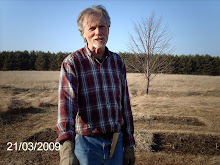
Today I had an inquiry from a friend about mowing with a scythe...and I'm passing along the advice that I sent him...
First, I am not an expert in any sense of the word, second, I had a bad experience with scythes when I was much younger, the one that I was given to use was heavy and dull - both of which made for a bad mowing experience...so I did a little research before I purchased one myself.
One of the first things that I learned was that there is a difference between European and American scythes - this was best explained in this article from the Scythe Supply.
The next step in learning for me was watching a mowing video - which shows what is possible...this one is of a 14 year old expert http://www.youtube.com/watch?v=ugSO54WKm8I
This Scythe buyer's guide probably contains way too much information for the casual reader but I found it to be very useful - and it caused me to begin looking for a local source to fit me with a good european style scythe and the tools that I need to maintain it.
Fortunately for me, this was about an hours drive away at http://mysticprairie.net/. Botan has a scythe shop and expertly fitted me with the correct scythe and was able to supply me with the instruction and tools that I needed to maintain my blade. He does ship scythes and accessories and you can e-mail him for a current price list. Botan also has a number of videos posted on youtoub http://www.youtube.com/watch?v=GdE3ZHRwo2c and other links from his website.
If you cannot find a local supplier of this quality here is another fabulous site that provides numerous blade choices and expert fitting http://www.scythesupply.com/index.htm.
If you want to look for a less expensive scythe, which has some maybe grudging endorsement from the scythe buyer's guide , Johnny's sells this "folding" one for a very low price. They also have an informational article on peening by scything expert Peter Vido. However, I would not purchase my accessories for sharpening and peening from Johnnny's.
Each person who is mowing with a scythe will need a sharpening stone and a holder for it that will contain water. It is essential to keep the blade sharp during mowing. I would start with just one hammer and anvil for peening (presumably not every blade will need to be peened at the same time) and I purchased a sandflex medium grain hand block for cleaning and polishing my blade after peening.
Tuesday, March 24, 2009

Monday, March 23, 2009
Emergence...
The first few seedlings of sacred tobacco, tobacco alata, and grandfather sage are beginning to emerge.
Sunday, March 22, 2009
Catch up...

Have sown a few more seeds - soaked 24hrs. - then planted 6 seeds of fennel, 6 seeds of cilantro, and 30 seeds of celeriac. Johnny's will be my primary seed source this year. I add a reference site from Cornell University that I have found useful for general information on nearly every crop that you can think of http://www.gardening.cornell.edu/index.html.
Have been mowing to harvest straw for garden needs.
Monday, March 16, 2009
Mooning...
Today after soaking overnight, I planted seeds of White Sage (Grandfather Sage), Native American (Sacred) Tobacco, and Tobacco Alata from The Redwood Seed Company - seeds were from last year. The moon is between full (3/11) and last quarter (3/18).
The Alata is supposed to be a night blooming fragrant flower which was eaten late last season before we ever saw it flower.
The Alata is supposed to be a night blooming fragrant flower which was eaten late last season before we ever saw it flower.

The Sacred Tobacco flowers (right) opened early and late in the day and attracted hummingbirds.
The white sage never did much of anything for me last year.
Sunday, March 15, 2009
In the beginning...
Today I planted a few sprouting garlic cloves to start the gardening season - here in the Indian Head region of Wisconsin.
This blog is to chronicle the exploits of this venture - the goal is to produce as much food as possible with the minimum of fossil fuel inputs.
Last year I had trial plots of mixed plantings design to grow "soil" - with local agrarian modifications to the "double dig" techniques advocated by John Jeavons in his book "How to grow more vegetables".
My objective is to build our soil - a Chetek Sandy Loam to a 5 or 6% organic matter - with the vegetation it supports naturally, green cover crops, and the household compost that we produce. I am using the Timberleaf Soil Testing service because of their familiarity with the Grow Biointensive methods.
According to our initial soil test (photo right)last May - our soil was 1.8% OM after 14 years of fallow - originally planted in Timothy.
This blog is to chronicle the exploits of this venture - the goal is to produce as much food as possible with the minimum of fossil fuel inputs.
Last year I had trial plots of mixed plantings design to grow "soil" - with local agrarian modifications to the "double dig" techniques advocated by John Jeavons in his book "How to grow more vegetables".
My objective is to build our soil - a Chetek Sandy Loam to a 5 or 6% organic matter - with the vegetation it supports naturally, green cover crops, and the household compost that we produce. I am using the Timberleaf Soil Testing service because of their familiarity with the Grow Biointensive methods.

According to our initial soil test (photo right)last May - our soil was 1.8% OM after 14 years of fallow - originally planted in Timothy.
Subscribe to:
Posts (Atom)